





Removes the barriers to the healing process
The only FDA-approved enzymatic debridement agent indicated for debriding BOTH chronic dermal ulcers and severely burned areas.2 The unique enzyme in SANTYL Ointment, Clostridial Collagenase, selectively removes necrotic tissue without harming healthy tissue.1,3
Four stages of wound healing
Most wounds will progress normally through the four stages of wound healing. However, some may "stall" in the inflammatory phase, leading to wound chronicity.4
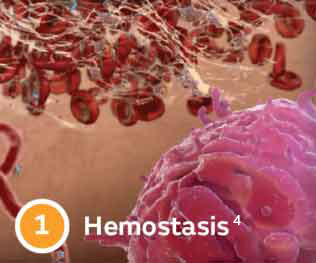
This phase is characterized by clot formation, which features a dynamic matrix of proteins and cells that provide critical support for incoming endothelial cells, fibroblasts and growth factors.4
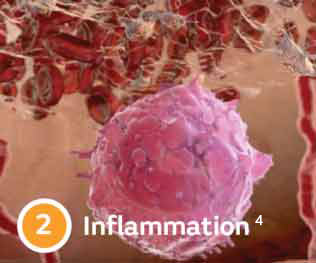
Neutrophils, macrophages and mast cells serve to remove debris, foreign particles and bacteria, produce collagen; and secrete growth factors.4
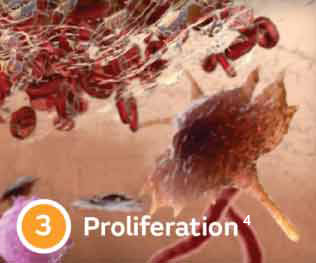
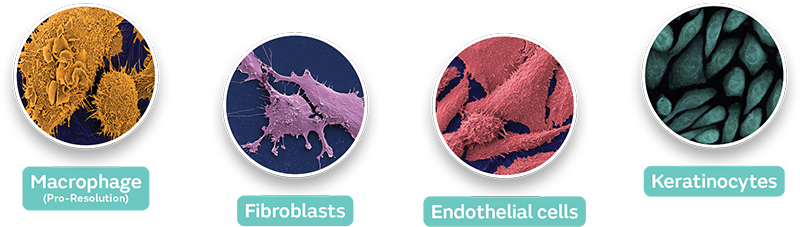
As inflammation resolves, granulation tissues begins to form and fibroblasts, endothelial cells and keratinocytes migrate to the wound site.4
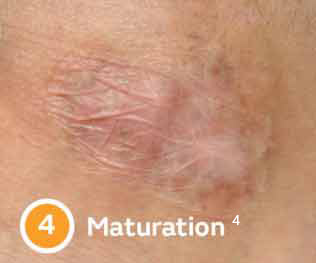
Collagen remodeling and epithelialization characterize this final phase of wound healing.4
Delays keep wounds chronic
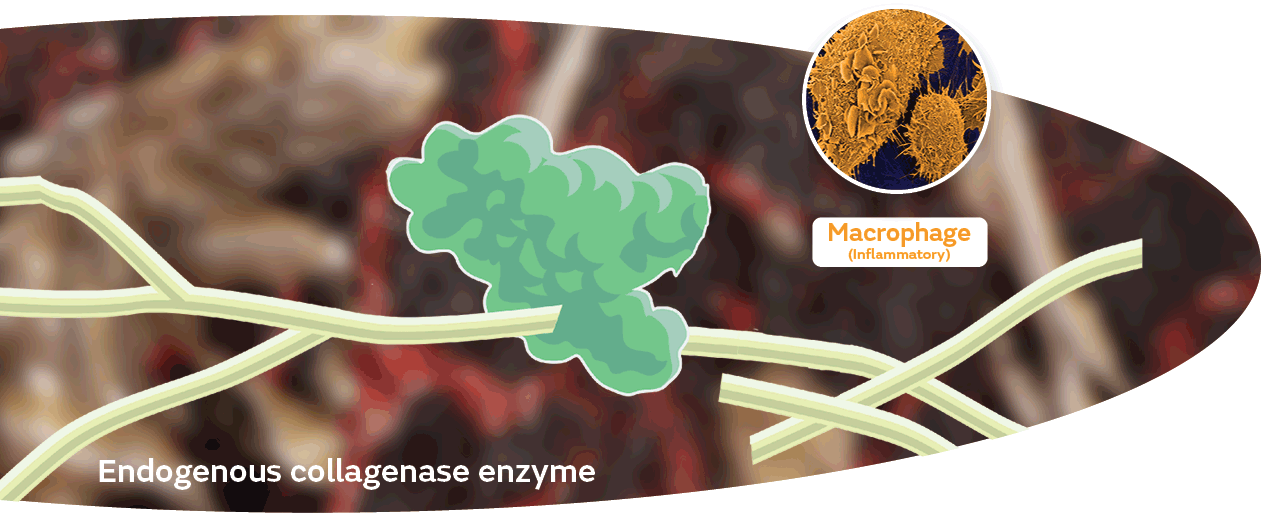
Wound chronicity can result from an imbalance of naturally produced enzymes (endogenous collagenase), resulting from comorbidities such as cardiovascular disease & diabetes.
Persistent, unresolved inflammation is a hallmark of chronic wounds.3 Macrophages are a pivotal cell type orchestrating the inflammatory response in the wound microenvironment.3
Why SANTYL Ointment?
SANTYL Ointment prepares the wound bed at the microscopic level
The uniquely active and selective enzyme cleaves collagen molecules at seven sites, simultaneously clearing necrotic tissue and generating collagen polypeptide fragments.3,5,6
SANTYL Ointment creates bioactive peptides7-9
- Break the cycle of inflammation10-12
- Recruit cells that lead to new tissue formation and blood vessel networks10-12
Build from the ground up with SANTYL Ointment
SANTYL Ointment has a wealth of established data to support its clinical efficacy11,24,28,31-36
- Collagenase SANTYL Ointment [prescribing information]. Fort Worth, TX: /Smith & Nephew, Inc.; 2016.
- Data on file. Smith & Nephew/SN strategic framework 2016.
- Enoch S, Harding K. Wound bed preparation: the science behind the removal of barriers to healing. Wounds. 2003;15:213-229.
- Baum, C.L. and Arpey, C.J. Normal cutaneous wound healing: Clinical correlation with cellular and molecular events. Dermatologic Surgery, 2005; 31: 674-686.
- Kim M, Hamilton SE, Guddat LW, Overall CM. Plant collagenase: unique collagenolytic activity of cysteine proteases from ginger. Biochim Biophys Acta. 2007;1770:1627-1635.
- French MF, Brown A, Van Wart HE. Identification of Clostridium histolyticum collagenase hyperreactive sites in type I, II, III collagens: lack of correlation with local triple helical stability. J Protein Chem. 1992;11:83-97.
- Herman, I. Stimulation of human keratinocyte migration and proliferation in vitro: insights into the cellular responses to injury and wound healing. Wounds. 1996; 8:33-40.
- Riley et al. Collagenase promotes the cellular responses to injury and wound healing in vivo. J Burns Wounds. 2005; 4:112-124.
- Shi et al. Degradation of human collagen isoforms by Clostridium collagenase and the effects of degradation products on cell migration. Int Wound J. 2010; 7: 87-95.
- Shi et al. Evaluation of anti- inflammatory effect of clostridium collagenase and its collagen degradation products. Wound Healing Society Poster 2011.
- Galperin et al. Anti-inflammatory effects of clostridial collagenase. J. Am. Podiatric Med. Assoc. 2015; 105: 509-519.
- Das et al. Novel mechanisms of Collagenase SANTYL Ointment (CSO) in wound macrophage polarization and resolution of wound inflammation. Scientific Reports 2018; 8: 1696.
- Frederick RE, Bearden R, Jovanovic A, Jacobson N, Sood R, Dhall S. Clostridium Collagenase Impact on Zone of Stasis Stabilization and Transition to Healthy Tissue in Burns. Int J Mol Sci. 2021;22(16):8643. Published 2021 Aug 11. doi:10.3390/ijms22168643.
- Shupp JW, Nasabzadeh TJ, Rosenthal DS, Jordan MH, Fidler P, Jeng JC. A review of the local pathophysiologic bases of burn wound progression. J Burn Care Res. 2010;31(6):849-873. doi:10.1097/BCR.0b013e3181f93571.
- Gravante G, Filingeri V, Delogu D, et al. Apoptotic cell death in deep partial thickness burns by coexpression analysis of TUNEL and Fas. Surgery. 2006;139(6):854-855. doi:10.1016/j.surg.2006.01.024.
- Gravante G, Palmieri MB, Esposito G, et al. Apoptotic death in deep partial thickness burns vs. normal skin of burned patients. J Surg Res. 2007;141(2):141-145. doi:10.1016/j.jss.2006.07.031.
- Khan AA, Rawlins J, Shenton AF, Sharpe DT. The Bradford Burn Study: the epidemiology of burns presenting to an inner city emergency department. Emerg Med J. 2007;24(8):564-566. doi:10.1136/emj.2005.027730.
- Hettiaratchy S, Dziewulski P. ABC of burns: pathophysiology and types of burns [published correction appears in BMJ. 2004 Jul 17;329(7458):148]. BMJ. 2004;328(7453):1427-1429. doi:10.1136/bmj.328.7453.1427.
- Salibian AA, Rosario ATD, Severo LAM, et al. Current concepts on burn wound conversion-A review of recent advances in understanding the secondary progressions of burns. Burns. 2016;42(5):1025-1035. doi:10.1016/j.burns.2015.11.007.
- Shi L, Carson D. Collagenase Santyl ointment: a selective agent for wound debridement. J Wound Ostomy Continence Nurs. 2009;36(6 Suppl):S12-S16. doi:10.1097/WON.0b013e3181bfdd1a.
- Sheets AR, Demidova-Rice TN, Shi L, Ronfard V, Grover KV, Herman IM (2016) Identification and Characterization of Novel Matrix-Derived Bioactive Peptides: A Role for Collagenase from Santyl® Ointment in Post-Debridement Wound Healing? PLoS ONE 11(7): e0159598.
- Jovanovic A, Ermis R, Mewaldt R, Shi L, Carson D. The influence of metal salts, surfactants, and wound care products on enzymatic activity of collagenase, the wound debriding enzyme. Wounds. 2012;24:242-253.
- Motley TA, Lange DL, Dickerson JE, Slade HB. Clinical outcomes associated with serial sharp debridement of diabetic foot ulcers with and without clostridial collagenase ointment. Wounds. 2014;26:57-64.
- Motley, T. A., Caporusso, J. M., Lange, D. L., Eichelkraut, R. A., Cargill, D. I., & Dickerson, J. E., Jr (2018). Clinical Outcomes for Diabetic Foot Ulcers Treated with Clostridial Collagenase Ointment or with a Product Containing Silver. Advances in wound care, 7(10), 339–348. doi:10.1089/wound.2018.0784.
- Lehrman, J, Patel A, Delhougne, J. Health Care Spending in Patients With Stage 3 and Stage 4 Pressure Injuries and Patients With Diabetic Foot Ulcers Treated Early With Clostridial Collagenase Ointment: A Retrospective Data Review. Wounds. 2020;32(8):228–236.
- Tallis A, Motley TA, Wunderlich RP, Dickerson JE Jr, Waycaster C, Slade HB. Clinical and economic assessment of diabetic foot ulcer debridement with collagenase: results of a randomized controlled study. Clin Ther. 2013;35:1805-1820.
- Leaper DJ, Schultz G, Carville K, et al. Extending the TIME concept: what have we learned in the past 10 years? IntWound J. 2012;9(Suppl2):1-19.
- Gilligan AM, Waycaster CR, Bizier R, Chu BC, Carter MJ, Fife CE. Comparative effectiveness of clostridial collagenase ointment to medicinal honey for treatment of pressure ulcers. Adv Wound Care (New Rochelle). 2017;6:125-134.
- In accordance with USP standards and guidelines and data on file.
- Data on file. Smith & Nephew, Inc. 2018.
- Tallis A, et al. Collagenase Diabetic Foot Ulcer Study Group. Clinical and economic assessment of diabetic foot ulcer debridement with collagenase: results of a randomized controlled study. Clin Ther.2013;35(11):1805–1820.
- Motley TA, et al. Clinical outcomes for diabetic foot ulcers treated with clostridial collagenase ointment or with a product containing silver. Adv Wound Care (New Rochelle). 2018;7(10):339–348.
- Jimenez JC, et al. Enzymatic debridement of chronic nonischemic diabetic foot ulcers: results of a randomized, controlled trial. Wounds. 2017;29(5):133–139.
- Milne CT, et al. A comparison of collagenase to hydrogel dressings in wound debridement. Wounds. 2010;22(11):270–274.
- Waycaster C, et al. Pressure ulcer treatment in a long-term care setting: wound bed healing with clostridial collagenase ointment versus hydrogel dressing. Chronic Wound Care Manage Res. 2014;1:49–56.
- McCallon SK, et al. A retrospective study of the effects of clostridial collagenase ointment and negative pressure wound therapy for the treatment of chronic pressure ulcers. Wounds. 2015;27(3):44–53.
- Hansbrough JF, et al. Wound healing in partial-thickness burn wounds treated with collagenase ointment versus silver sulfadiazine cream. J Burn Care Rehabil. 1995;16(3 Pt 1):241–247.
- Gilligan AM, et al. Comparative effectiveness of clostridial collagenase ointment to medicinal honey for treatment of venous leg ulcers in outpatient care settings. Presented at: 7th Annual SAWC. September 2015;26–28.
- Carter MJ, et al. Treating pressure ulcers with clostridial collagenase ointment: Results from the US Wound Registry. Wound Repair Regen. 2016;24(5):904–912